Today’s Guardian featured an Opinion piece by Nell Frizzell, framed in terms of offering an unusual way of dealing with grief. It majored on a story of how, when the goddess Demeter was in mourning for her daughter Persephone, an old woman called Baubo cheered her up by lifting her clothes to show the goddess her vulva.
As Frizzell wrote, it’s difficult for us to see why this would make a sad goddess laugh. So tht would make it a classic example of how we move between assuming the people of the past were just like us, and being surprised when we meet something which challenges that assumption. The past is a foreign country, and all that: but the ancient Greeks and Romans are also held up as our cultural ancestors, so we desperately want to make sense of them.
But there’s far more going on here. It’s also a classic example of how, when the written sources, are few and far between, we elide them without much thought. Unfortunately, the ‘myth of Baubo’ as told in this Opinion piece doesn’t actually exist. The source for the story of Baubo is from the late seventh or early sixth century BC: the Homeric Hymn to Demeter, lines 203–4, where the old woman Iambe makes the goddess laugh after Persephone’s abduction by the god of the Underworld. Just a moment: Iambe? Not Baubo? No, indeed. And nothing about lifting her clothing, no details of what was so funny; perhaps Iambe just told a joke. The name Baubo and the more surprising story that she ‘uncovers her secret parts’ to the goddess comes from the second-century AD Christian writer Clement of Alexandria, Protrepticus, 20.1–21.1. That work is a great source on ancient Greek pagan cults, but seen through the eyes of a Christian; and it’s written nearly a millennium after the Homeric Hymn.
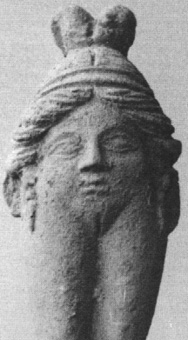
Frizzell’s article was headed by a picture labelled as ‘a terracotta figurine of Baubo from the fourth century AD’. Where even to start with this? Maybe by noting that the identification is speculative and the date entirely wrong. More broadly, though, it’s an example of the urge to make connections between literature and art. Modern scholars have sometimes tried to tie otherwise puzzling physical objects to equally mysterious fragments of text; for example, what’s shown at the start of that article is one of the ‘Priene terracottas’, found in Turkey in 1898, which are far older than the caption suggests, dating to the third or early second century BC. They seem to merge a female lower torso and a face. There’s nothing to link them to Baubo, but the urge to make a connection is very strong.
There are other stories from across a long period of Mediterranean history that feature the display of the female body: Egyptian women worshipping the god Apis by lifting their skirts, assumed by scholars to be a fertility ritual; another Egyptian custom described by the historian Herodotus, where women travelling by barge to a festival at Bubastis lift their skirts and shout abuse at the women of the towns through which the river passes; and a group of stories in which women lift up their clothes to their fleeing husbands in order to shame them into returning to the battlefield. And there’s Agnodice, the ‘flashing midwife’ of ancient Athens, about whom I’ve written extensively: none of them, however, provides an exact parallel.
The audience may matter. Agnodice, working in male disguise, lifts up her clothes to reassure potential clients that she is a woman just like them. The Bubastis barge women, and indeed Baubo, are flashing at other women. But there’s a very different audience in another set of classical stories in which women lift up their clothes; in these, it happens in front of their husbands, who are running away from the battlefield. In some such stories, the women’s words are along the lines of ‘Where do you think you’re going? Are you trying to get back into the wombs which gave you birth?’ That suggests a contrast between a baby and a Real Man. But it also hints that, here at least, it’s not the external genitalia which are on display so much as the belly, and the womb beneath it. Women can do something men can’t: have babies.
So maybe what’s on display to Demeter isn’t supposed to be the vulva, but the whole belly. Intriguingly, that brings us back to those terracottas. They seem to show a face drawn on the belly, with the raised clothing forming a sort of hair line. The vulva, such as it can be seen, becomes a sort of cleft chin. Had Baubo/Iambe drawn a face on her body, and it was that – rather than anything intrinsically funny about women’s bodies – which so surprised the goddess?
Frizzell’s article opens with ‘Most of us in Britain don’t know quite what to do with grief’. The Baubo/Iambe/Demeter story shows that we don’t know quite what to do with ancient texts and objects, either.

 Mistaking histories